The Bible has been translated into English a number of times. In 1380, John Wiclif, aka “The Morning Star of the Reformation,” was the first to translate the entire Bible into English. But he did it using the Latin Vulgate. Tyndale followed in 1534, Cranmer in 1539, the Geneva Bible in 1557, and then the Puritan Bible, written by William Whittingham and Anthony Gilby—a Bible which Queen Mary of England did not want translated into English—with margins containing over 300,000 notes to help in the understanding of the scriptures. This Bible was printed from 1560–1644.
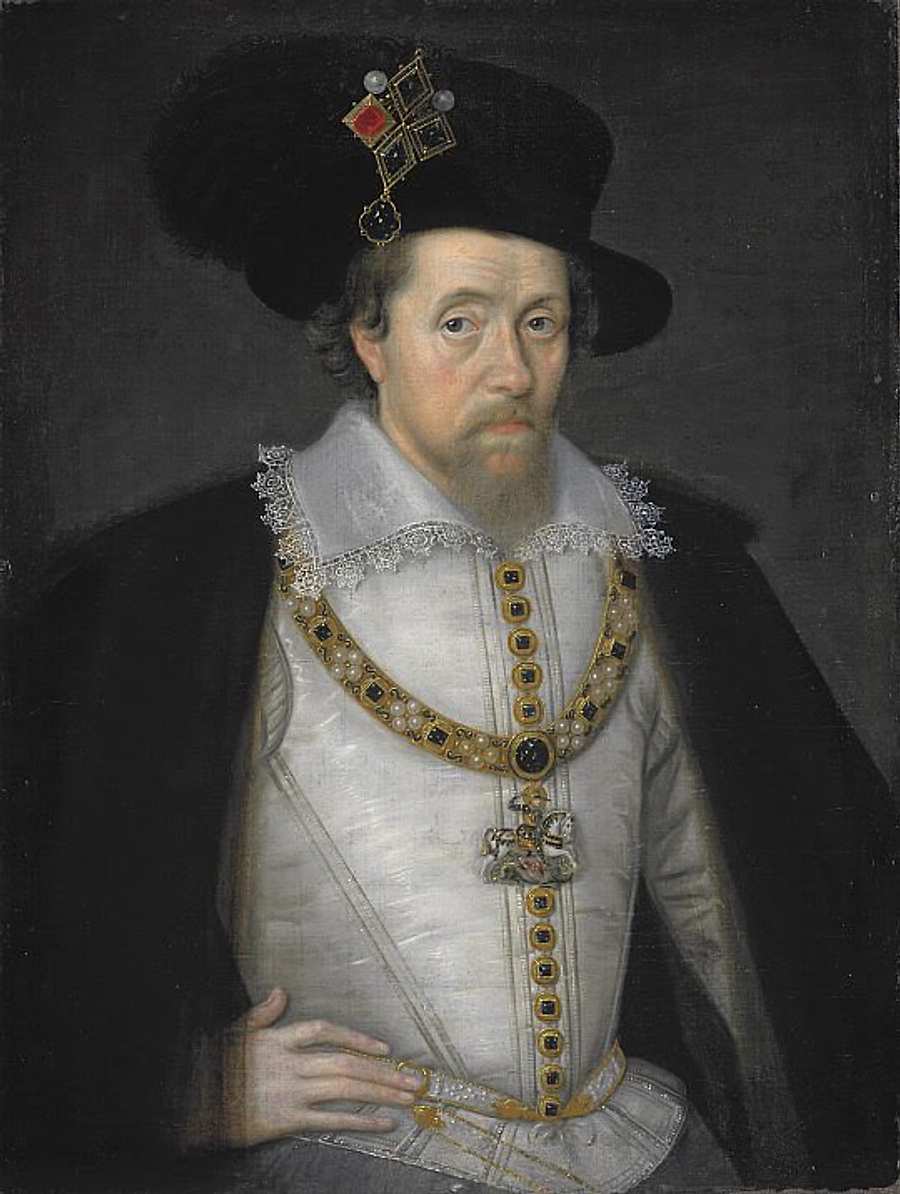
The King James Version followed in 1611. This translation was done using the original scrolls in Hebrew and Greek and commissioned by King James Charles Stuart, who was born on June 19, 1566 at Edinburgh Castle in Scotland.
The Translators Of The 1611 KJV
There were 40 translators of the Bible. Each translator was directly commissioned by King James. The majority of the translators were doctors of divinity from the University of Cambridge, Oxford University, Trinity College and Westminster.
The First Westminster Company
Translated the books beginning with Genesis, through to the end of the Second Book of Kings. This section of the Bible’s interpretation is widely considered the best work of all the interpretations. The translators were as follows.
Lancelot Andrews — He was appointed to one of the first Greek Scholarships of Pembroke Hall, in the University of Cambridge, and also received a complimentary appointment as Fellow of Jesus College, Oxford. He was made parson of Alton, in Hampshire, then Vicar of St. Giles, in London, and afterwards Prebendary and Canon Residentiary of St. Paul’s, and of the Collegiate Church of Southwark. In 1589 he was chosen Master of Pembroke Hall. While Dean of Westminster, Dr. Andrews was made director, or president, of the first company of translators, composed of ten members, who held their meetings at Westminster. He was consecrated Bishop of Chichester on November 3rd, 1605—soon after his appointment to be one of the translators of the Bible.
Hadrian Saravia — Invited to become Professor of Divinity at the University of Leyden in 1582, and soon after made preacher of the French Church in that city. In 1587 he came to England with the Earl of Leicester, and became master of the grammar school in Southampton. In 1590, Saravia was made Doctor of Divinity at Oxford, then Prebendary of Gloucester, next of Canterbury in 1595, and then of Westminster in 1601.
Richard Clarke — Vicar of Minster and Monkton in Thanet, and one of the six preachers of the cathedral church in Canterbury.
John Laifield — Fellow of Trinity College, Cambridge, and Rector of the Church of St. Clement’s, Dane’s, in London.
Robert Tighe — Educated partly at Oxford and partly at Cambridge. He was Archdeacon of Middlesex and Vicar of the Church of All Hallows, Barking, London.
Francis Burleigh — Made Vicar of Bishop’s Stortford in 1590, which benefice he held at the time of his appointment to the Bible translation.
Geoffry King — Fellow of King’s College, Cambridge. He succeeded Mr. Spaulding, another of these translators, as Regius Professor of Hebrew in that University.
Richard Thompson — At the time of his appointment, Fellow of Clare Hall, Cambridge.
William Bedwell — Educated at St. John’s College, Cambridge. Vicar of Tottenham High Cross, near London. He invented a ruler for geometrical purposes, like what we call Gunter’s Scale, which went by the name of “Bedwell’s Ruler.”
The Cambridge Company
Translated Chronicles to the end of the Song of Solomon.
Edward Lively — A student, and afterwards a fellow, of Trinity College, Cambridge, and King’s Professor of Hebrew. He was actively employed in the preliminary arrangements for the translation, and was author of a Latin exposition of five of the minor Prophets, and of a work on chronology.
John Richardson — First Fellow of Emanuel College, then Master of Peterhouse and next Master of Trinity College. Also King’s Professor of Divinity, and chosen Vice-Chancellor of the University in 1617 and again in 1618.
Lawrence Chaderton — Took his first degree in 1567 and was then chosen one of the Fellows of his College, becoming Master of Arts in 1571 and Bachelor of Divinity in 1584. He did not receive the degree of Doctor of Divinity until 1613, when it was pressed upon him. For sixteen years he was lecturer at St. Clement’s Church, in Cambridge.
Francis Dillingham — Fellow of Christ’s College, Cambridge. After the translation was finished, he became parson of Dean, his native place, in Bedfordshire, and published a Manual of the Christian Faith, taken from the Fathers, and various treatises on the Romish controversy.
Roger Andrews — Fellow in Pembroke Hall, and Master of Jesus College, Cambridge. He also became Prebendary of Chichester and Southwell. His brother was Lancelot, the Bishop of Winchester.
Thomas Harrison — Student and Fellow of Trinity College, Cambridge, and Vice-Master of that seminary.
Robert Spaulding — Fellow of St. John’s College, Cambridge. He succeeded Edward Lively as Regius Professor of Hebrew.
Andrew Bing — Fellow of Peterhouse, Cambridge. He succeeded Geoffry King in the Regius Professorship of Hebrew, was Sub-dean of York in 1606, and was installed Archdeacon of Norwich in 1618.
The Oxford Company
Translated the beginning of Isaiah to the end of the Old Testament.
Dr. John Harding — At the time of his appointment, had been Royal Professor of Hebrew in the University for thirteen years, and was also President of Magdalen College.
Dr. John Reynolds — First entered Merton College in 1562, became a Fellow in 1566 at the age of seventeen, and six years later was made Greek Lecturer in his college and appointed by the Queen to be Royal Professor of Divinity in the University.
Dr. Thomas Holland — Educated at Exeter College, Oxford, graduating in 1570. Made chaplain and Fellow of Balliol College, then Doctor in Divinity in 1584. In 1589 he succeeded the celebrated Dr. Lawrence Humphrey as King’s Professor of Divinity, and was elected Rector of Exeter College in 1592. He took a very prominent part in the translation, calling it the crowning work of his life. He died March 16th, 1612, a few months after the version was completed and published, at age seventy-three.
Richard Kilby — Went to Oxford, and after three years was chosen Fellow of Lincoln College. In 1590 he was chosen Rector of his College, and made Prebendary of the cathedral church of Lincoln. Considered so accurate in Hebrew studies that he was appointed the King’s Professor in that branch of literature, and was also so perfect a Grecian that he was appointed by King James to be one of the translators of the Bible.
Dr. Miles Smith — Wrote the preface to the Bible in the original translation. He went to Corpus Christi College, then in 1568 attended Brazen Nose College, where he took his degrees, and was one of the chaplains of Christ’s Church. In 1594 he was made Doctor in Divinity. He had a four-fold share in the translation, serving in the third company and as one of the twelve selected to revise the work, after which it was referred to the final examination of Dr. Smith and Bishop Bilson. Dr. Smith was employed to write the preface to the Bible, “the Translators to the Reader,” which has become rare and seldom seen by readers of the Bible.
Dr. Richard Brett — Entered at Hart Hall, Oxford, where he took his first degree, then was elected Fellow of Lincoln College. In 1595, Rector of Quainton in Buckinghamshire. Made Doctor in Divinity in 1605. He was skilled and versed in the Latin, Greek, Hebrew, Chaldee, Arabic, and Ethiopic tongues.
Daniel Fairclough (otherwise known as Dr. Daniel Featley) — Admitted to Corpus Christi College in 1594, elected Fellow in 1602. Appointed chaplain to Dr. Abbot, Archbishop of Canterbury, also one of the translators, by whom he was made Rector of Lambeth, in Surrey. The Archbishop gave him the rectory of Allhallows Church, Bread Street, London, which he later exchanged for the rectory of Acton, in Middlesex. He was also Provost of Chelsea College, and, at one time, chaplain in ordinary to King Charles the First.
The Second Oxford Company
Translated the four Gospels, the Acts of the Apostles, and the Revelation of St. John the Divine.
Dr. Thomas Ravis — Graduated Bachelor of Arts in 1578, Master of Arts in 1581, Bachelor in Divinity in 1589, and Doctor in Divinity in 1595. Appointed rector of the Church of All-hallows, Barking, London, in 1591. The next year, Canon of Westminster, occupying the seventh stall in that church. Two years later, chosen Dean of Christ’s Church College, and in 1596 and the year following, elected Vice-Chancellor of the University. In 1598 he exchanged his benefice at All-hallows for the rectory of Islip, and also held the Wittenham Abbey Church, in Berkshire. In 1604, soon after he was commissioned as one of the Bible translators, the Lords of the Council requested his acceptance of the bishopric of Gloucester.
Dr. George Abbot — At fourteen, entered as a student of Balliol College, Oxford, and in 1583 was chosen to a fellowship. In 1585 he took orders and became a popular preacher in the University. Created Doctor of Divinity in 1597, and a few months after, elected Master of University College. Made Bishop of Lichfield and Coventry on December 3rd, 1609.
Dr. Richard Eedes — Became a student of Christ’s Church, Oxford, in 1571, subsequently took two degrees in arts and two more in divinity. In 1578 he became a preacher. In 1584 he was made Prebendary of Yarminster, in the cathedral church of Salisbury, and two years later became Canon of Christ’s Church and chaplain to Queen Elizabeth. In 1596, Dean of Worcester.
Dr. Giles Tomson — Entered University College, Oxford, in 1571, and in 1580 was elected Fellow of All Souls’ College. He was made divinity lecturer in Magdalen College, chaplain to Queen Elizabeth, became Doctor in Divinity in 1602, and in that year was appointed Dean of Windsor, acting as Registrar of the most noble Order of the Garter. He took great pains in his part of the translation, which he did not long survive—consecrated Bishop of Gloucester June 9th, 1611, and died a year later, June 14th, 1612, at fifty-nine.
Sir Henry Savile — Graduated at Brazen Nose College, Oxford, but afterwards became a Fellow of Merton College, and became tutor in Greek and mathematics to Queen Elizabeth.
Dr. John Peryn — Of St. John’s College, Oxford, elected Fellow in 1575. He was the King’s Professor of Greek in the University and afterwards Canon of Christ’s Church, created Doctor of Divinity in 1596. When placed in the commission to translate the Bible, he was Vicar of Wafting in Sussex.
Dr. Ralph Ravens — Vicar of Eyston Magna, made Doctor of Divinity in 1595.
Dr. John Harmar — Educated in William de Wykeham’s School at Winchester, and also at St. Mary’s College, becoming a Fellow of his College in 1574. Appointed King’s Professor of Greek in 1585. Headmaster of Winchester School for nine years, and Warden of his College for seventeen years. Became Doctor of Divinity in 1605.
The Fifth Company Of Translators At Westminster
Translated all of the Epistles of the New Testament. The fifth company was composed of seven divines, who held their meetings at Westminster.
Dr. William Barlow — President of this company. A student of Trinity Hall, Cambridge, graduating in 1584, Master of Arts in 1587, admitted to a fellowship in Trinity Hall in 1590. Seven years later, Archbishop Whitgift made him sinecure Rector of Orpington in Kent. In 1601 the prebendship of Chiswick was conferred upon him, held until he was made Bishop of Lincoln. In 1603 he became, at the same time, Prebendary of Westminster and Dean of Chester, holding the latter to the day of his death. The King granted Dr. Reynolds’s motion for a new translation of the Bible, to be prepared by the ablest divines in his realm.
Dr. John Spencer — A student of Corpus Christi College, Oxford, graduating in 1577. Elected Greek lecturer for that College at nineteen, chosen Fellow of the same College in 1579, and Master of Arts in 1580. He entered into orders and became a popular preacher, eventually one of King James’ chaplains. In 1589 he was made Vicar of Alveley in Essex, resigned in 1592 for the vicarage of Broxbourne, and in 1599 was Vicar of St. Sepulchre’s, beyond Newgate, London. He was made President of Corpus Christi College, and appointed to a prebendal stall in St. Paul’s, London, in 1612—a valuable helper in preparing the common English version of the Bible.
Dr. Roger Fenton — Fellow of Pembroke Hall, Cambridge. Minister of St. Stephen’s, Walbrook, London, admitted in 1601. Also presented by the Queen to the Rectory of St. Bennet’s, Sherehog, resigned in 1606 for the vicarage of Chigwell, in Essex. Also collated, in place of Bishop Andrews, to the Prebendship of Pancras in St. Paul’s cathedral, where he was Penitentiary of St. Paul’s.
Dr. Ralph Hutchinson — At the time of his appointment, President of St. John’s College, having entered that office in 1590.
William Dakins — Educated at Westminster School, admitted to Trinity College, Cambridge, May 8th, 1587. Chosen Fellow in 1593, Bachelor in Divinity in 1601. The next year appointed Greek lecturer, and in 1604 appointed Professor of Divinity at Gresham College, London—elected on the recommendation of the Vice Chancellor and Heads of Colleges in Cambridge, several of the nobility, and the King himself, as remuneration for his undertaking to do his part in the Bible translation, considered peculiarly fit for the work on account of his skill in the original languages. In 1606 he was chosen Dean of Trinity College, but died a few months after, on the second of October, less than forty years of age.
Michael Rabbet — Bachelor in Divinity, and Rector of the Church of St. Vedast, Foster Lane, London.
There have been a number of other English translations since the KJV, but most of them have borrowed from the KJV.
The Canons
The term Bible refers to the collections of canonical religious writings of Judaism and of Christianity.
Canonical—this word is used by theologians and canon lawyers to refer to the canons of the Roman Catholic, Eastern Orthodox and Anglican Churches adopted by ecumenical councils.
In the 20th century, the Roman Catholic Church revised its canon law in 1917 and then again in 1981, into the modern Code of Canon Law. This code is no longer merely a compilation of papal decrees and conciliar legislation, but a more completely developed body of international church law, analogous to the English system of Statute law.
Canonical can also mean “part of the canon”—i.e., one of the books comprising the biblical canon, as opposed to apocryphal books. Canonization is the process by which a person is recognized as a saint.
Canon law is the term used for the internal ecclesiastical law which governs various churches, most notably the Roman Catholic Church, the Eastern Orthodox Churches, and the Anglican Communion of churches.
The books considered “canon” in the Bible vary depending upon the historic tradition using or defining it. These variations are a reflection of the range of traditions and councils that have convened on the subject.
The Jewish version of the Bible, the Tanakh, or Torah, is divided into three parts: the Teaching, the Prophets, and the Writings.
The Christian version of the Bible includes books of the Tanakh, but includes additional books and reorganizes them into two parts: the books of the Old Testament, primarily sourced from the Tanakh (with some variations), and the 27 books of the New Testament, written primarily in Greek. Some versions of the Christian Bible have a separate Apocrypha section for the books not considered canonical by the tradition or sometimes the publisher.
As of 2016, the Bible, or some portion of it, has been translated into more than 2,300 languages or dialects, most all of which are born from the original translation of the KJV.


